
Criminal Court Cases in Delta County
The Delta Combined Court brings two Colorado trial levels into one clerk's office in the Seventh Judicial District. Delta County District Court hears felony prosecutions and other matters within its higher jurisdiction. Delta County Court handles misdemeanors, petty offenses, traffic cases, and initial proceedings assigned by law. Both operate at 501 Palmer Street, Suite 338, in Delta. The clerk can be reached at 970-874-6280 on weekdays from 8:00 a.m. to 4:30 p.m.
A criminal file begins when the prosecutor files a complaint or information, or when a grand jury returns an indictment. That point matters. An officer's arrest charge can change before filing, and some arrests never become a court case. The court record is the best source for the filed count, hearings, plea, motions, disposition, sentence, restitution, and later probation or postconviction events. It is not a countywide rap sheet. Each file documents one case in that court.
Delta County Criminal Court Levels
Choosing the correct court prevents a fruitless search. The courthouse clerk serves both District and County Court, but a request should name the level when known. City ordinance cases remain with a municipal court. They are not divisions of the Delta Combined Court, even when the conduct occurred within Delta County.
| Court | Criminal work | Access route |
|---|---|---|
| Delta District Court | Felonies and higher-jurisdiction matters | Combined Court docket and clerk |
| Delta County Court | Misdemeanors, petty offenses, traffic, and initial matters | Combined Court docket and clerk |
| Delta Municipal Court | City charter and ordinance cases | Municipal clerk at 360 Main Street |
| Cedaredge or Paonia Municipal Court | Town ordinance matters | Respective town court |
Delta Municipal Court holds Wednesday sessions beginning at 8:30 a.m. and can be reached at 970-874-7914. A person checking an event in Cedaredge or Paonia should also test the town court route. Serious state-law charges generally move to the Combined Court, while a local ordinance count may stay municipal.
Delta County Case Record Searches
Start at the official Delta Combined Court page and follow its docket link. A docket can confirm scheduled activity and help identify a case, but it does not supply every pleading, exhibit, or order. Colorado Judicial Branch also describes commercial public-access vendors for real-time registers of action. Those vendor views are not the official record and do not replace copies issued by the filing court.
| Party name | Use the full legal spelling and any known middle name. |
|---|---|
| Case number | The strongest key because it identifies the court, year, type, and sequence. |
| Court location | Select Delta and distinguish District, County, or municipal court. |
| Date range | Narrow filing or hearing dates when the name is common. |
| Case type | Separate criminal, traffic, and other docket categories. |
| Hearing date | Use the local docket to confirm a scheduled courtroom event. |
If the public search fails, call the clerk. Older material, a spelling difference, a recently filed case, or a restricted file may not appear as expected. Give the clerk a name, approximate filing date, case type, and case number if available. Do not send a court request through Delta County NextRequest. County government expressly says that system does not hold court records.
Order Delta County Court Documents
The docket is an index; the clerk's copy is the record. The official Judicial record and document request form asks for requester contact details, court location, case number, party names, the document sought, a date range, certification choice, delivery method, and payment authorization. Use plain terms such as complaint, register of actions, plea, sentencing order, or disposition. A precise request reduces search time and makes it less likely that similarly named cases will be confused.
Copies can also be requested from or reviewed with the third-floor clerk. Fees depend on the type and status of the requester, and the form explains that parties or their attorneys may have a capped charge while other requests follow Judicial Branch fees. Ask for a certified copy when another official process requires proof that the copy came from the court. Certification is not needed for every personal review.
The official court page shows the Delta Combined Court and its public-access details.
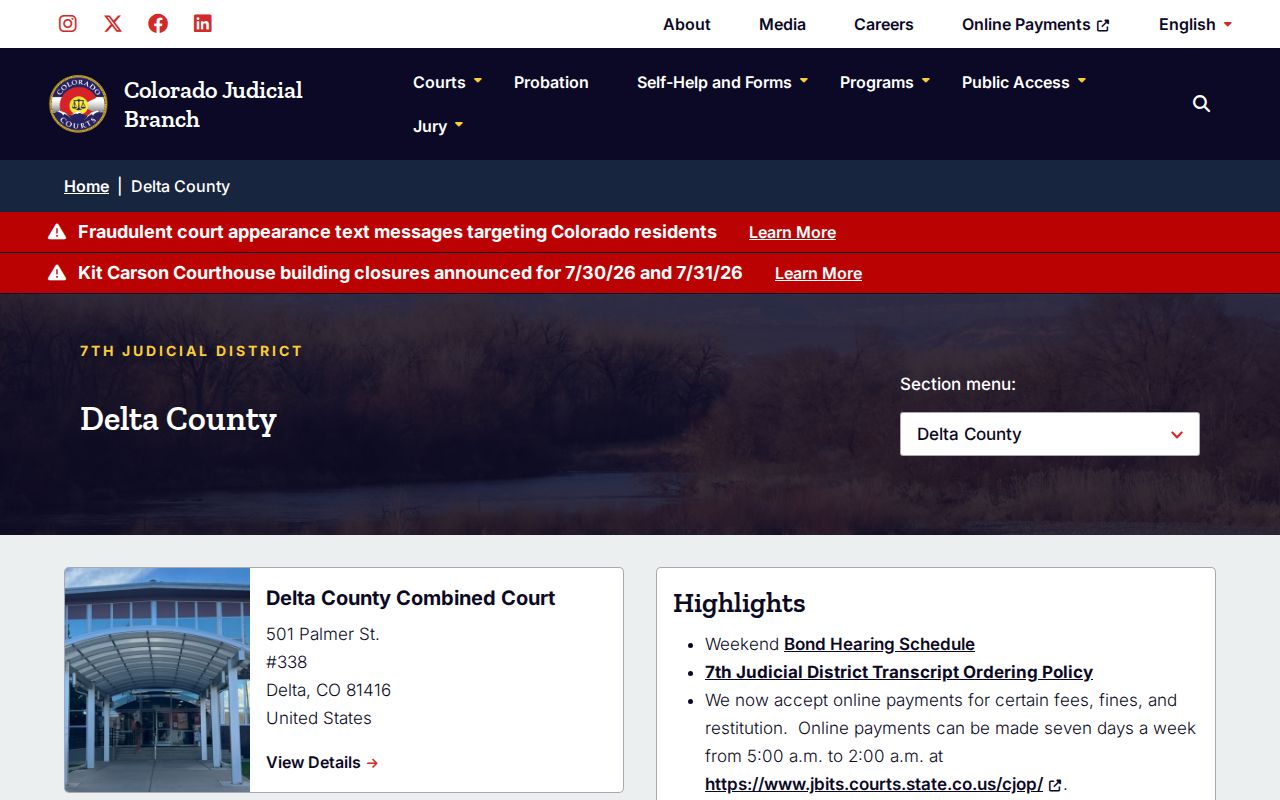
The court page anchors a request to the filing office rather than a county administrative custodian.
What a Criminal Case File Contains
A Delta County criminal case file joins separate events into a court timeline. The complaint or information states what the prosecutor filed, while the register of actions logs hearings and documents. Motions show what the parties asked the judge to decide. Orders record the rulings. The disposition must be read count by count because one charge may be dismissed while another results in a plea or verdict.
| Case number | Unique court identifier used for docket and document requests. |
|---|---|
| Filed charges | Counts accepted for prosecution, which may differ from arrest allegations. |
| Parties and counsel | Defendant, prosecution, defense counsel, and assigned judicial officer where public. |
| Docket entries | Chronological filings, hearings, continuances, motions, and orders. |
| Plea or verdict | Outcome for each count, not merely the overall case status. |
| Disposition and judgment | Dismissal, acquittal, conviction, deferred result, or other final action. |
| Sentence and conditions | Custody, probation, fines, restitution, and court-ordered terms where public. |
Some items are not open. Victim identifiers, protected medical facts, juvenile material, sealed content, and security-sensitive information may be removed or withheld. An online entry can be less complete than the official file. Ask the clerk what is public rather than assuming a blank search proves that no case exists.
Read Delta County Docket Entries
A register of actions is the court's chronological index. It is useful, but its short labels need context. “Closed” means the court has ended its active handling at that stage; it does not mean every count produced a conviction. A dismissal, acquittal, completed deferred judgment, or transfer can also close a case. Read the charge disposition and judgment entry together.
- Advisement
- A first court event where rights, allegations, and release issues are addressed.
- Arraignment
- The stage at which a plea is entered to filed charges.
- Disposition
- The result of a charge, such as dismissal, plea, acquittal, or conviction.
- Minute order
- A short record of what occurred or was ordered at a hearing.
- Mittimus
- A formal order carrying the judgment and sentence into effect.
- Postconviction
- A later request challenging or changing a final criminal judgment.
When a label remains unclear, request the linked order or minute entry. The register can show that a motion was filed without revealing its full grounds. It can also show a sentence without all conditions contained in the written order.
Criminal Case Stages in Delta County
A filed Delta County criminal case moves through distinct checkpoints. Timing varies with custody, discovery, motions, negotiations, trial scheduling, and case complexity. No fixed local timetable should be inferred from a docket.
Case flow: Charges Filed › Arraignment › Pretrial › Plea or Trial › Disposition › Sentencing
Before arraignment, an arrest or summons may lead to a first appearance and release review. Prosecutors then define the filed counts. During pretrial work, the parties exchange discovery, litigate motions, and hold conferences. A plea resolves many cases; otherwise, a trial leads to a verdict. Sentencing follows a conviction, and restitution may be decided then or later. Appeals, postconviction motions, and probation violations can add entries after judgment. The Delta County arrest search covers the earlier agency and booking records that a court file does not replace.
Delta Arrest Charges Can Change
The charge recorded at booking is an arrest-time allegation. Prosecutors review reports and decide what can be filed in court. They may file a different degree, add or omit counts, or decline a case. That is why a booking label should never be used as a substitute for the complaint and disposition.
To reconcile the two records, match the person's identifiers, arrest date, agency case number, and court case number. Then compare each filed count with its final result. CBI may later receive the arrest cycle and disposition, but reporting gaps can leave a state history without the last outcome. For one's own record, obtain a certified court disposition and use CBI's correction process if a result is missing or wrong.
Certified Delta County Case Copies
A certified copy carries the clerk's authentication that it matches the official court record. It can be useful when a person must prove a disposition, correct a reported result, or document a case for a sealing process. Request the exact judgment, dismissal, or sentencing document rather than asking for an undefined “background check.”
The official request interface identifies court, case, document, certification, and delivery choices.
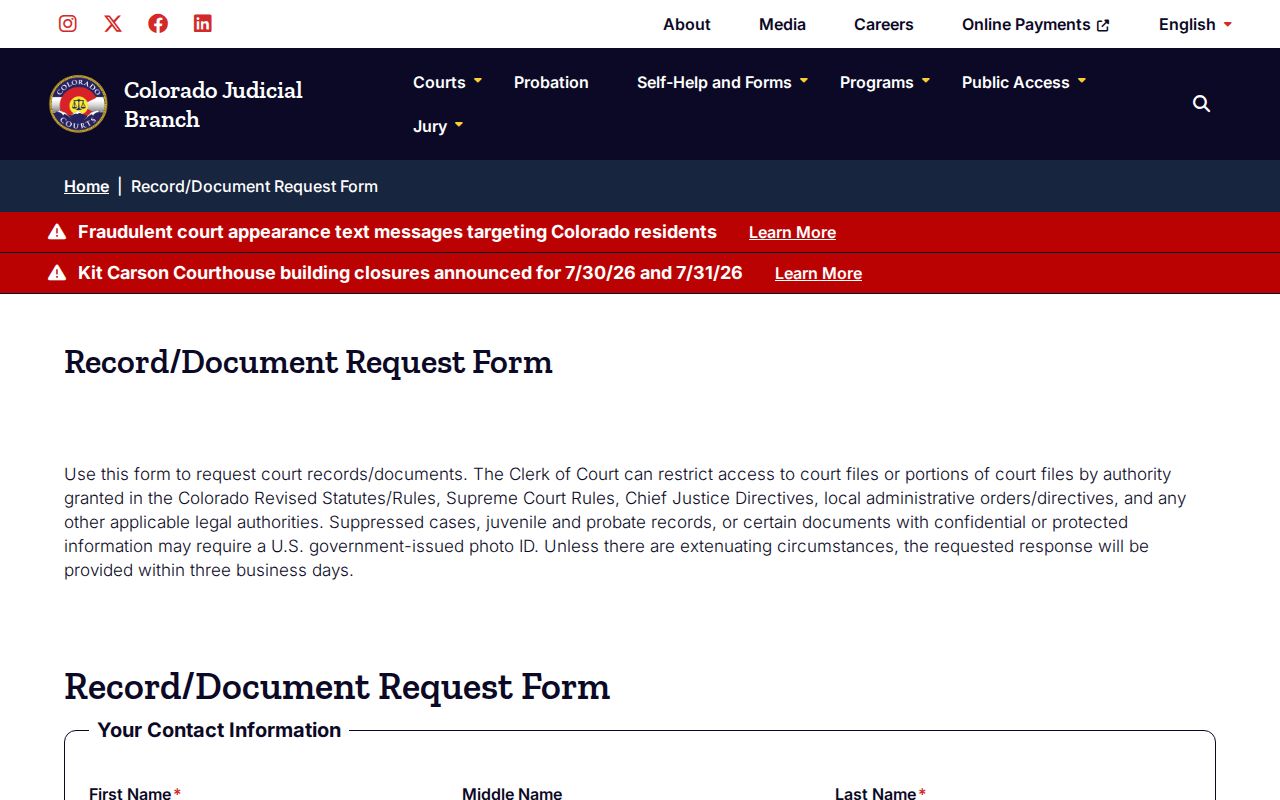
Those fields help the Delta clerk locate the correct file and provide the form of copy actually needed.
Access Rules for Case Records
Court records follow Colorado Judicial Branch policy, chiefly Chief Justice Directive 05-01. They are not obtained under the Colorado Open Records Act through county administration. Public access is broad, but it is not absolute. Sealed cases, juvenile records, protected victim data, certain warrants and investigative materials, and information restricted by law may be hidden or redacted.
The Judicial Branch public-access explanation distinguishes vendor registers from official documents.
That distinction explains why a name search can help locate a file while the Delta filing court remains the authoritative document source.
If a case does not appear, ask the clerk whether the search details are wrong, the filing is too recent, the matter belongs to municipal court, or access is restricted. Staff can explain procedure and available copies, but they cannot provide legal advice. A subject-only Colorado sealed-case confirmation tool may help someone check an automatic sealing result, yet it is not a public name search for another person's sealed case.